Intelligent Classification Tool for Landscape Architecture Images
I. Problems Addressed and Product Positioning
Classification of images in the landscape industry often encounters two problems: first, the efficiency of manual annotation is low. Thousands of images such as parks and classical gardens need to be classified one by one, which not only takes time, but also has different judgment standards for different people, and is prone to error; Second, ordinary image classification tools do not fit the landscape, such as the inability to distinguish between “green space attached to buildings” (with buildings and green space) and “courtyard garden”, and the inaccuracy in identifying the cornices, tiles and other details of classical gardens.
For these pain points, we developed the prototype of intelligent classification tool for landscape image based on deep learning technology. It is not a substitute for manual audit, but a positioning “industry adaptive auxiliary tool”, which is specifically targeted at five common garden scenes, such as parks, classical gardens, courtyard gardens, city squares, and building affiliated green spaces. It uses optimized models (such as ResNet50 and fine tuned multimodal models) to automatically classify, helping practitioners reduce duplication of labor, reduce the rate of miscarriage of justice, and adapt to the image processing, scene statistics and other needs of design companies and garden management departments.
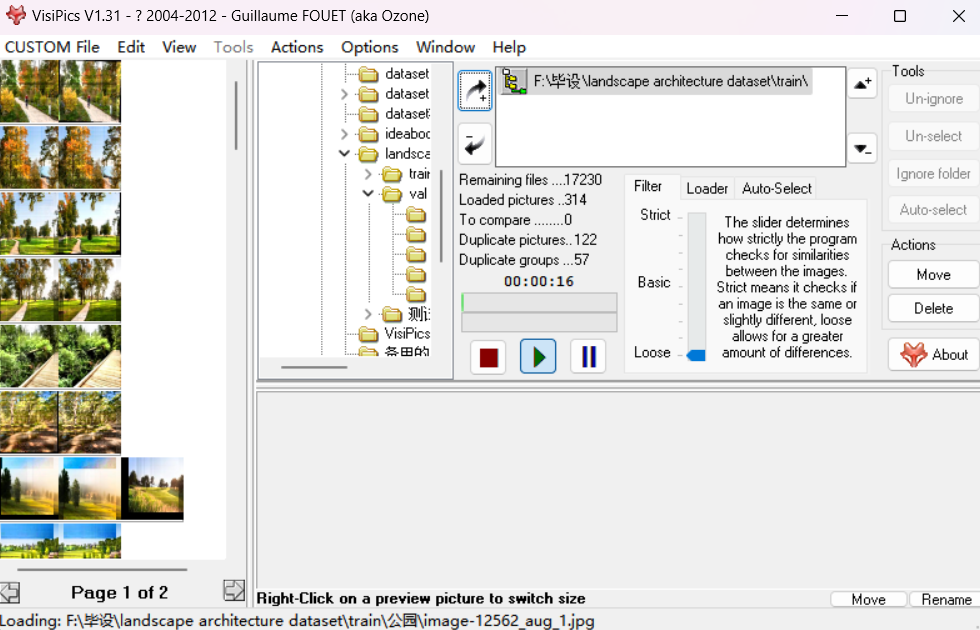 Figure 1 Image Processing Workflow
II. Practical Value and Results
From the perspective of testing, the tool can solve the core requirements:
The classification efficiency has been improved. Previously, it took half a day to manually process 1,000 landscape images. Now the system can be completed within half an hour. It can also automatically remove the duplicate and reduce the interference of redundant images. What’s more, the classification accuracy rate is stable. For scenes with obvious characteristics such as classical gardens and city squares, the accuracy rate is more than 90%. Even for complex scenes such as green space attached to buildings, the misjudgment rate is 40% lower than that of ordinary tools. In addition, It is suitable for landscape industry scenes and can distinguish the unique details of gardens. For example, it will not misjudge the “Pavilions” of classical gardens as ordinary buildings and help users reduce the workload of subsequent manual correction.
At present, the tool has been able to stably handle five types of mainstream garden scenes, but there is still room for optimization in terms of subdivision requirements, such as adapting to different regional landscape styles (such as classical gardens in the south of the Yangtze River and royal gardens in the North), and integrating them into the mobile terminal after lightweight (convenient for on-site photo classification).
If you are a landscape design company needing to quickly organize project image libraries, or a garden management department requiring statistics on jurisdictional green space type distribution, we welcome your contact. We can provide customized tool adjustments, such as adding refined scene classifications and integrating with existing management systems, collaboratively implementing intelligent classification technology in practical work to improve landscape image processing efficiency and accuracy.